


The root cause of war
Here, I would like to revisit the philosophy of war. War is terrible, yet it shows no sign of disappearing. Have you read The Art of War? It is one of the best-selling books in history, which suggests that the causes of war continue to surround us. Why, then, do we choose the path of warfare, even though it is costly, tragic, and ultimately destructive? Moreover, as we move closer to the brink of battle, our fear of death only intensifies. For this reason, understanding the underlying causes of war is far from simple.
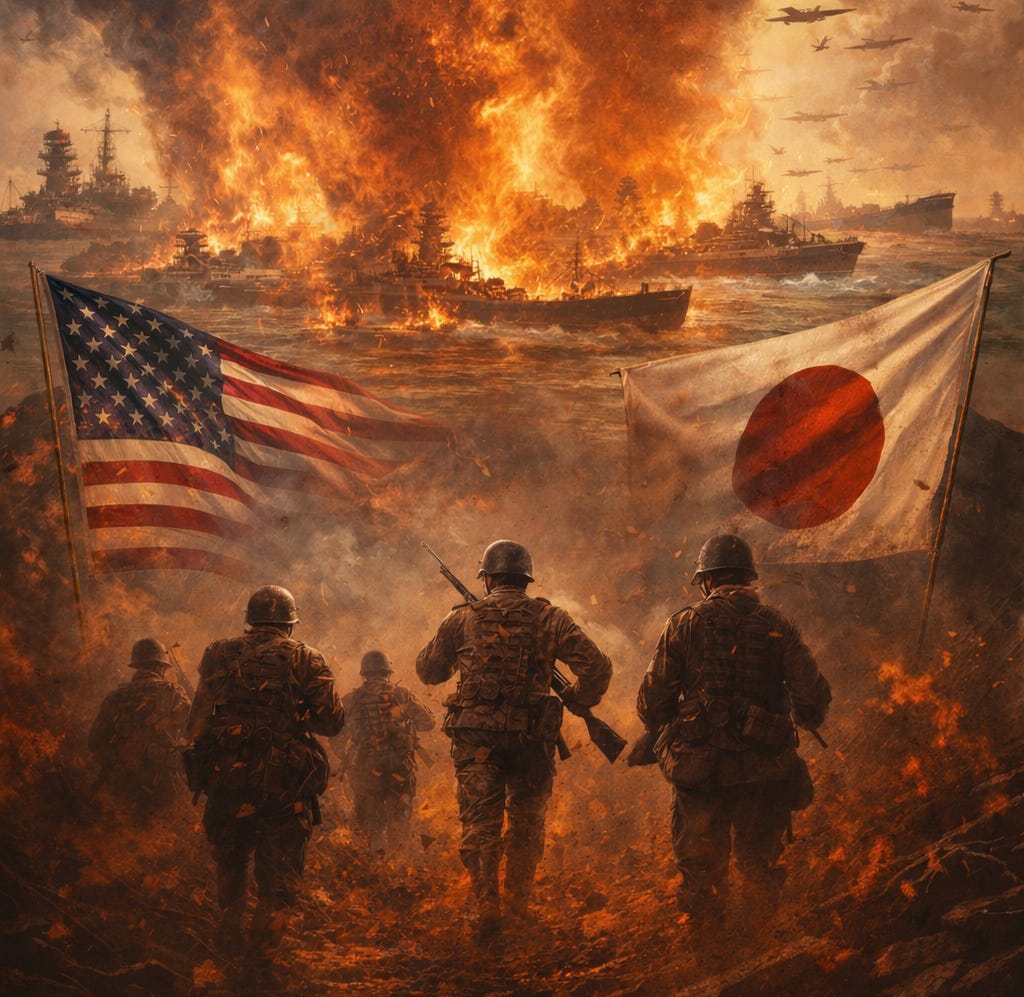
When we examine World War II, we encounter numerous tragic events in human history. If it were possible to alter this shameful past, one might earnestly wish to erase such events from our collective memory. However, such a feat is beyond human capability. Among the many accounts of World War II, one can discern the reasons behind the Japanese Empire’s decision to wage war against the United States: a deep fear of losing everything if they capitulated to the U.S.
At that time, the Japanese government recognized that they were no match for the USA, with an economy only one-tenth the size. Nevertheless, due to comprehensive economic sanctions imposed by the USA, they felt compelled to engage in the conflict. Notably, they imported 80% of their oil from the USA. These sanctions proved devastating to Japan’s economy, and they found themselves embroiled in a war for control of the Manchuria region, encompassing the northern Korean Peninsula and mainland China. Given their circumstances, they had no alternative but to fight to ensure their survival, effectively rendering them incapable of ceasing hostilities against any potential adversary. Consequently, they determined that a surprise attack on Pearl Harbor was their only recourse.
What becomes evident is that the pervasive fear of death within the Japanese Empire pushed them to instigate the Pacific War against the USA. This situation brings to mind the phrase, ”The stag at bay is a dangerous foe.”
Had they managed their fear of death wisely and restrained their greed for territorial expansion, they might have found a path to peace. Undoubtedly, they committed numerous sins—including greed, pride, and murder—which shaped their legacy. Their pursuit of Korea as a colony for their own gain led to heinous crimes, as did their invasions of China and Manchuria. Given their transgressions against other nations, it became increasingly difficult for them to trust others in a cutthroat world. This reality continues to shape international relations even today.
What if they had refrained from invading and instead helped other nations prosper? This notion may seem overly idealistic, for throughout Asian history, countries in the region have often hurt each other repeatedly. How could the long-standing cycle of vengeance be broken overnight? Consequently, each country continues to grapple with deep-seated traumas and fears, leading to a situation where nations interact primarily out of fear of death.
However, if you read this book carefully, you will come to understand that all fear originated in the Garden of Eden when Adam, the first man, faced the sentence of death. Since that moment, humanity has lived under the constant threat of death. This fear exerts its influence not only on individuals, families, and communities but also on the global stage.
Every day, humanity awakens with fear, goes about its tasks with fear, and strives to reach the pinnacle, all while haunted by the fear of death. It is a profound affliction that we, as a species, endure. This issue is not inconsequential; we must deeply comprehend the far-reaching consequences of the fear of death for all of us.
Dear readers, you are on this journey with me. Please understand that this journey will take some time. First, I deeply appreciate your patience.
And if you complete this journey with me, I will help you find freedom, fundamental solutions, and eternal answers in this book, “The Fear of Death.”
I hope you will continue reading “The Fear of Death” until the very end. Let’s keep going together.

morning Isaac, I was really moved by your reflection. Youre touching something very deep—the way fear, especially the fear of death, can shape human choices. However, wars usually grow out of many layers at once: economic presure, political ideology, military calculations, pride, misunderstanding, and yes, fear. In the case of Japan and the United States before World War II, historians often point not only to fear, but also to expansionist policies, imperial ambitions, and long-term strategic decisions that had been building for years.